


High Impact Risk Management

High Impact High Prevalence Risk Guidance Resource

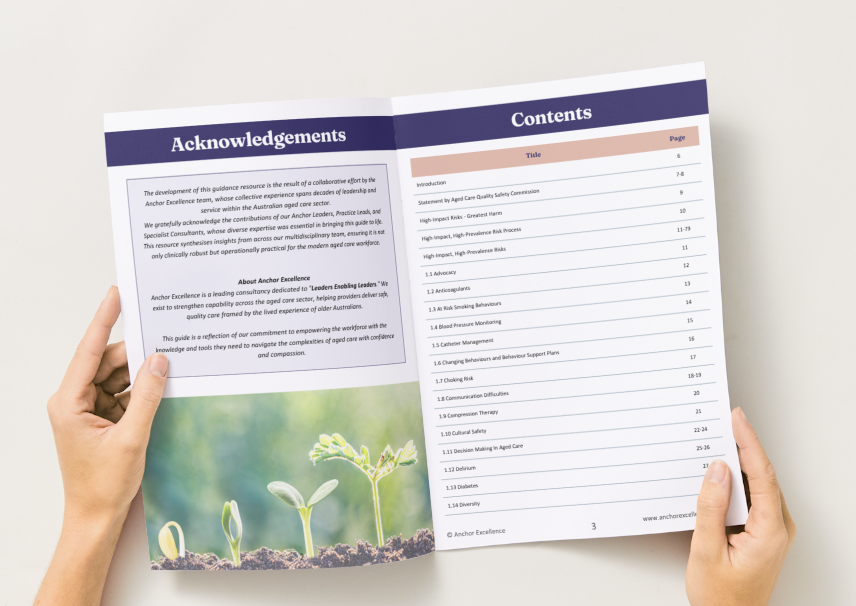
The HIHP Risk Guidance Resource is an 88-page, evidence-based guide that helps aged care teams identify and manage the 48 high impact, high prevalence risks that cause the greatest harm to older people. It is written for clinical and care staff across residential care, home care, and retirement living, and it maps to the Aged Care Act 2024 and the strengthened Aged Care Quality Standards. 

Produced by Anchor Excellence. 

ISBN 978-1-7644323-1-3.

Filters Sort results
Reset Apply

High Impact High Prevalence Risk Guidance Resource

This comprehensive, 80-page resource booklet guides aged care workers in implementing person-centred, evidence-based practices for managing high-impact, high-prevalence risk related to the Individual. Purchase your copy today!

$ 25.00
Max:
Min: 1
Step: 1
Add to cart

Buy the HIHP resource book!

Enquire through the button below for tailored pricing and options.

Produced by Anchor Excellence · Aligned to the Aged Care Act 2024 · ISBN registered · Written by a multidisciplinary aged care team

What are high impact, high prevalence risks in aged care?

High impact, high prevalence (HIHP) risks are the clinical and care risks that occur often in aged care and carry a high likelihood of serious harm, which is why the Aged Care Quality and Safety Commission expects providers to identify and actively manage them. Falls, pressure injuries, medication-related harm, and restrictive practices are common examples. Under the strengthened Quality Standards, and Standard 5 Clinical Care in particular, providers must show they recognise each individual's HIHP risks and manage them through their clinical governance framework.

The HIHP Risk Guidance Resource turns that expectation into practical guidance your workforce can use at the point of care.

What's inside the resource?

The resource covers 48 HIHP risk areas across 88 pages, each written as practical, person-centred guidance rather than theory. Alongside the risk topics, it includes a statement from the Aged Care Quality and Safety Commission, a framework for the HIHP risk process, and the "greatest harm" view of where risk concentrates.

It also includes two appendices, the Aged Care Code of Conduct and the Statement of Rights, an evidence-base list, and a CARE NOTES poster for the floor.

The HIHP Risk Guidance Resource is an 88-page guide covering 48 high impact, high prevalence risk areas, from falls and pressure injuries to medication management, restrictive practices, and end-of-life care.

The 48 Risk Areas

Clinical and physical

Falls Prevention, Pressure Injury Prevention and Management, Wound Management, Skin Integrity, Choking Risk, Malnutrition, Unplanned Weight Loss, Managing Hydration and Nutrition, Infection Prevention and Management, Sepsis, Delirium, Diabetes, Pain Management, Palliative and End of Life Care, Oral Health, Non-Weight-Bearing, Compression Therapy, Oxygen Therapy, Intravenous (IV) Therapy, Catheter Management, Stoma Care, Urinary Tract Infections, Continence, Blood Pressure Monitoring, Anticoagulants, Fluid Restriction.

Medication

Medication Management, Psychotropic Medicines, Polypharmacy, Managing Time-Sensitive Medicines.

Behaviour, cognition and rights

Changing Behaviours and Behaviour Support Plans, Responsive Behaviours, Restrictive Practices, Decision Making in Aged Care, Advocacy, Cultural Safety, Diversity, Privacy and Dignity, Elder Abuse, Social Isolation, Trauma-Aware and Healing-Informed Care.

Sensory, communication and safety

Hearing Loss, Visual Impairment, Communication Difficulties, At Risk Smoking Behaviours, ETOH Consumption and Alcohol Abuse, Unexplained Absence, Transitions in Care.

Who is the resource for?

The resource is written for the people delivering and overseeing care: registered nurses, direct care workers, clinical leaders, and quality and governance teams, across residential aged care, home care, and retirement living. Teams use it three ways: to onboard new staff, to refresh existing staff, and to prepare for an Aged Care Quality and Safety Commission audit.

The resource is written for the people delivering and overseeing care

How does the resource help with audits and clinical governance?

The resource gives you a consistent, evidence-based reference for HIHP risk that supports your clinical governance framework and the evidence you need for registration and renewal audits. It is designed to be contextualised through your own framework, across your systems, policies, processes, competencies, people, and practices, rather than used as a standalone checklist. That makes it useful when you are demonstrating to an assessor that your workforce understands the risks and that your governance actively manages them.

For providers building the evidence trail for the Care Delivery Evidence Collection Tool (CDECT) or preparing for a registration renewal, it works as a shared reference across the team.

Why Anchor Excellence?

Anchor Excellence is an aged care consultancy built on the idea of leaders enabling leaders. The resource was written by a multidisciplinary team of Anchor leaders, practice leads, and specialist consultants whose experience spans decades across the Australian aged care sector, which is what keeps it clinically sound and practical for a working shift. Anchor Excellence is part of the Anchor Impact Group.

New to Leading in Aged Care: The Service Manager
Filters Sort results
Reset Apply

High Impact High Prevalence Risk Guidance Resource

This comprehensive, 80-page resource booklet guides aged care workers in implementing person-centred, evidence-based practices for managing high-impact, high-prevalence risk related to the Individual. Purchase your copy today!

$ 25.00
Max:
Min: 1
Step: 1
Add to cart

Produced by Anchor Excellence · Aligned to the Aged Care Act 2024 · ISBN registered · Written by a multidisciplinary aged care team

Frequently Asked Questions

What are high impact, high prevalence (HIHP) risks in aged care?

High impact, high prevalence (HIHP) risks are the care risks that happen frequently in aged care and carry a high chance of serious harm, such as falls, pressure injuries, medication harm, and restrictive practices. The Aged Care Quality and Safety Commission expects providers to identify each individual's HIHP risks and manage them through their clinical governance framework, and Standard 5 Clinical Care makes this explicit under the strengthened Aged Care Quality Standards.

What's included in the HIHP Risk Guidance Resource?

The HIHP Risk Guidance Resource is an 88-page guide covering 48 high impact, high prevalence risk areas, from falls and pressure injuries to medication management, restrictive practices, and end-of-life care. It also includes a statement from the Aged Care Quality and Safety Commission, the HIHP risk process, the Aged Care Code of Conduct, the Statement of Rights, an evidence-base list, and a CARE NOTES poster. Anchor Excellence produces it, ISBN 978-1-7644323-1-3.

Who is the HIHP resource for?

The HIHP resource is written for registered nurses, direct care workers, clinical leaders, and quality and governance teams across residential aged care, home care, and retirement living. Teams use it to onboard new staff, refresh existing staff, and prepare for an Aged Care Quality and Safety Commission audit.

How many risks does the resource cover?

The resource covers 48 high impact, high prevalence risk areas across 88 pages. They span clinical and physical risks such as falls, wounds, and sepsis, medication risks including psychotropics and polypharmacy, and behaviour, cognition, and rights topics such as restrictive practices, elder abuse, and decision making in aged care.

How does the HIHP resource help with ACQSC audits and CDECT evidence?

The HIHP resource gives your team a consistent, evidence-based reference for HIHP risk that supports the evidence you present at a registration or renewal audit and in the Care Delivery Evidence Collection Tool (CDECT). It is designed to be applied through your own clinical governance framework, so it helps you show an Aged Care Quality and Safety Commission assessor that staff understand the risks and that governance actively manages them, rather than sitting as a standalone document.

Can we get a branded version of the resource?

Yes. Anchor Excellence produces a tailored edition of the HIHP Risk Guidance Resource with your organisation's branding, so it fits within your own onboarding and education materials. Enquire through the tailored edition button on the page for pricing and options.

How much does the HIHP resource cost?

The HIHP Risk Guidance Resource is $25.00 through the Anchor Excellence website, postage and tax excluded. A tailored, branded edition is available by enquiry, and organisations wanting copies for a whole team can ask about volume options at the same time.

How does the resource align with the Aged Care Act 2024 and the strengthened Standards?

The resource is written around the Aged Care Act 2024 and the strengthened Aged Care Quality Standards, and Standard 5 Clinical Care in particular, which require providers to manage high impact, high prevalence risk. It also carries the Aged Care Code of Conduct and the Statement of Rights, the core obligations every aged care worker is expected to meet, so the guidance sits inside the current regulatory framework rather than a superseded one.